
Memory shapes who we are. It connects us to our families, preserves our life experiences, and allows us to pass wisdom, traditions, and values from one generation to the next. While no one can predict whether they or a loved one will develop dementia, taking steps to preserve memories before cognitive decline begins is one of the most meaningful gifts a person can leave behind. Recording personal stories, family history, photographs, videos, and life lessons helps ensure that identity is never lost—even if memory changes over time.
More than 55 million people worldwide are living with dementia, and that number is expected to increase significantly as populations age (World Health Organization [WHO], 2023). Alzheimer’s disease remains the most common cause of dementia, accounting for approximately 60–70% of all cases (WHO, 2023). Although researchers continue to advance treatments and improve early diagnosis, there is currently no cure. This reality highlights the importance of preserving memories while individuals can still comfortably share their experiences, relationships, beliefs, and personal history.
Preserving memories is not only valuable for individuals at risk of dementia. It benefits every family by documenting stories that might otherwise disappear with time. Every voice, every photograph, every family tradition, and every lesson learned contributes to a legacy that future generations can continue to cherish. Rather than waiting until memory loss becomes noticeable, families who begin documenting life stories early create lasting connections that celebrate identity, strengthen relationships, and provide comfort throughout the dementia journey.
Why It Is Important to Preserve Memories Early
Many families assume there will always be time to ask meaningful questions, organize family photographs, or record personal stories. Unfortunately, dementia often develops gradually, and subtle memory changes may occur years before a formal diagnosis. Once memories become difficult to retrieve, valuable family history and personal experiences may be permanently lost.
Early memory preservation allows individuals to tell their stories in their own words while they can recall details with greater clarity. Childhood experiences, military service, career achievements, cultural traditions, family recipes, spiritual beliefs, friendships, parenting experiences, travel adventures, and life lessons become permanent records that future generations can revisit for decades.
Research suggests that reflecting on one’s life through reminiscence and life review contributes to emotional well-being, life satisfaction, and a stronger sense of identity throughout later adulthood (Butler, 1963). Recording memories also provides opportunities for meaningful conversations between parents, grandparents, children, and grandchildren, strengthening family relationships while creating new shared experiences.
Children benefit significantly from understanding their family’s history. Studies indicate that individuals who know more about their family’s stories often demonstrate greater resilience, emotional security, and confidence because they see themselves as part of a continuing family narrative (Duke et al., 2008). Learning how previous generations overcame adversity, celebrated traditions, built careers, or cared for one another provides inspiration while strengthening family identity.
Preserving memories also supports future caregiving. Personal stories, favorite music, hobbies, occupations, religious beliefs, important relationships, and lifelong routines become valuable resources that help caregivers understand the individual beyond a medical diagnosis. This information supports person-centered care that respects dignity while fostering emotional connection.
Ways to Preserve Memories Before Dementia
Preserving memories has never been more accessible. Modern technology allows families to capture stories in multiple formats while creating secure digital archives that remain available across generations. The best method is the one that encourages authentic storytelling and reflects the individual’s personality.
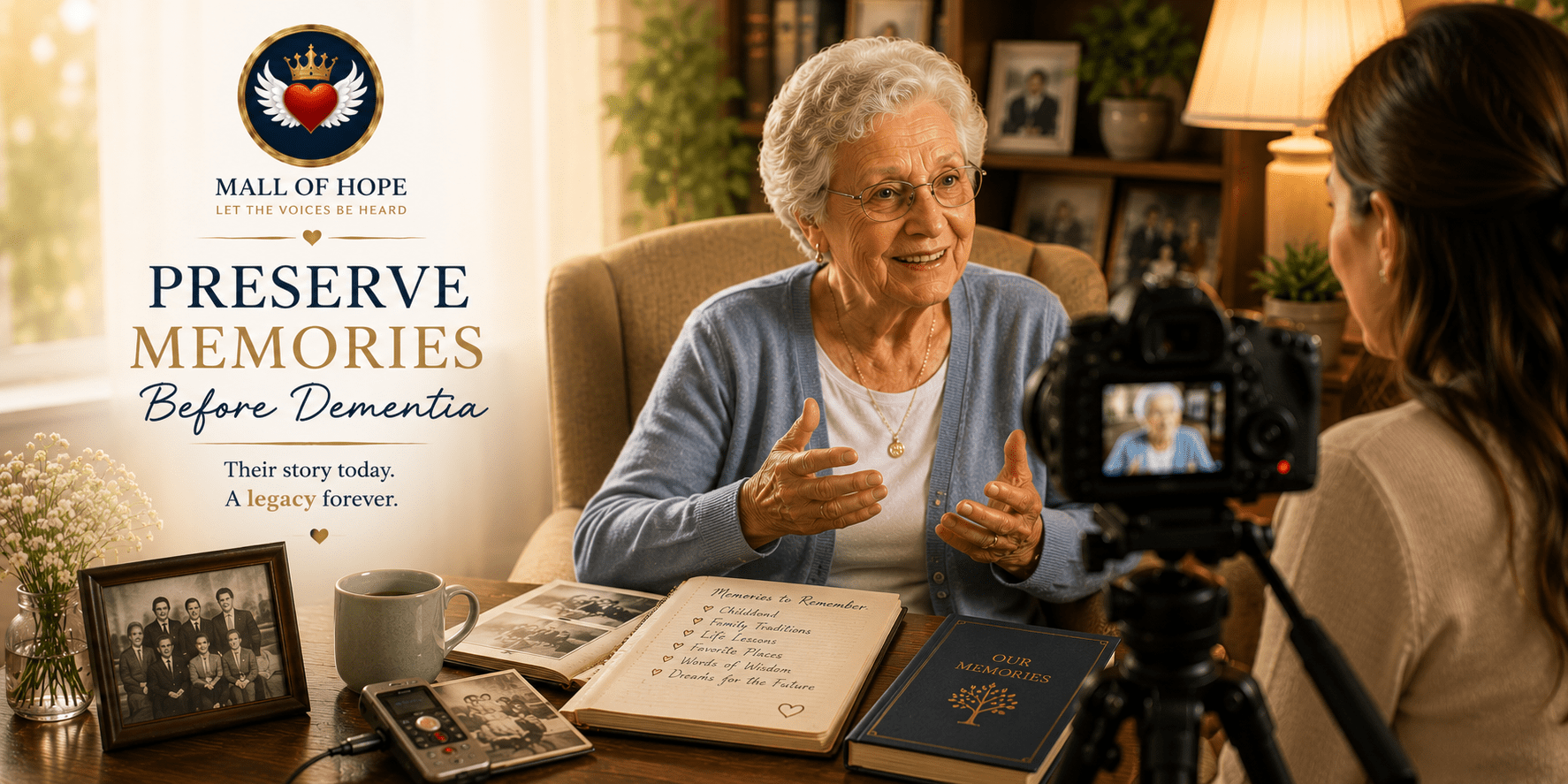
Life story interviews remain one of the most effective approaches. Sitting with a trusted family member or interviewer and answering thoughtful questions creates meaningful conversations that preserve experiences, values, and personal reflections. Topics may include childhood, education, marriage, careers, military service, immigration, faith, community involvement, parenting, favorite traditions, and advice for future generations.
Video recording adds another powerful dimension by preserving facial expressions, laughter, gestures, and tone of voice. Future generations often describe hearing a loved one’s voice and seeing their smile as one of the most treasured aspects of legacy preservation. Audio recordings provide similar emotional benefits while requiring only a smartphone or digital recorder.
Written memoirs and journals allow individuals to organize memories chronologically or thematically. Some families create memory books that combine written stories with photographs, letters, newspaper clippings, recipes, certificates, military records, and family trees. These collections become valuable genealogical resources while preserving family identity.
Photographs should also be identified and organized before memories fade. Many families possess albums filled with unlabeled images that future generations cannot fully appreciate because names, dates, and locations have been forgotten. Digitizing photographs and adding captions ensures these visual memories remain meaningful.
Digital legacy platforms provide opportunities to combine interviews, videos, photographs, genealogy records, scanned documents, and family timelines into searchable archives. Secure cloud storage protects these materials from physical damage while making them accessible to relatives regardless of geographic location.
Regardless of the format chosen, authenticity is more important than perfection. Honest conversations, spontaneous laughter, emotional reflections, and everyday stories often become the most meaningful parts of a preserved family legacy.
Memory Preservation and Person-Centered Dementia Care
Preserving memories before dementia is not only an act of legacy building—it is also a practical component of compassionate healthcare. Person-centered dementia care recognizes that understanding an individual’s history, relationships, values, and preferences leads to better care experiences throughout the progression of the disease (Kitwood, 1997).
When families document memories early, caregivers gain valuable insight into the person’s life beyond medical information. Knowing that someone spent decades as a teacher, musician, nurse, veteran, farmer, artist, or business owner influences conversations and recreational activities while reinforcing identity. Favorite songs, treasured family traditions, hobbies, recipes, religious practices, and meaningful places all contribute to individualized care that promotes comfort and emotional well-being.
Life story books and recorded interviews frequently become practical resources in home care, assisted living, and memory care communities. Professional caregivers can use personal histories to develop meaningful activities, reduce anxiety, and establish stronger relationships with residents. Rather than viewing someone only through symptoms of dementia, caregivers gain a fuller understanding of the remarkable life that continues to define the individual.
Memory preservation also benefits family caregivers emotionally. Watching a recorded interview or listening to a loved one’s stories provides comfort throughout the progression of dementia and after the person’s passing. These recordings preserve personality, humor, wisdom, and affection that written documents alone cannot fully communicate.
Research supports the use of reminiscence and life story work as non-pharmacological approaches that encourage meaningful engagement and improve quality of life for many individuals living with dementia (Woods et al., 2018). By beginning this work before significant cognitive decline occurs, families create lasting resources that remain valuable throughout every stage of care.
Creating a Legacy That Lives Beyond Memory
Every family possesses stories worth preserving. Some tell of extraordinary accomplishments, while others celebrate everyday acts of kindness, resilience, sacrifice, faith, and love. Together, these experiences create a legacy that extends far beyond material possessions.
Preserving memories before dementia allows individuals to leave future generations with something deeply personal—the opportunity to hear their voice, understand their values, and learn from their experiences. Family traditions, favorite recipes, cultural heritage, military service, career milestones, parenting wisdom, travel adventures, and life lessons become lasting gifts that strengthen identity across generations.
Genealogists recognize oral history as one of the most valuable companions to documentary research. Birth certificates, census records, military documents, and family trees establish historical facts, but personal stories explain the meaning behind those records. Recording memories fills the gaps that official documents cannot capture, creating richer and more complete family histories.
Long-term preservation requires thoughtful planning. Families should maintain multiple digital backups using encrypted cloud storage and external hard drives while periodically updating file formats to remain compatible with future technology. Written transcripts improve accessibility and allow recordings to be searched by names, locations, and important events. Labeling photographs, organizing digital folders, and documenting interview dates further strengthen long-term preservation.
Memory preservation should also become an ongoing family tradition rather than a one-time project. Recording interviews during birthdays, anniversaries, reunions, and holidays encourages continued storytelling while adding new chapters to the family’s history. Every generation has experiences worth documenting, and every story contributes to a richer understanding of family identity.
Ultimately, dementia may affect memory, but it does not erase the significance of a person’s life. By preserving memories before dementia, families protect the voices, experiences, relationships, and values that define those they love. These preserved stories continue teaching, comforting, and inspiring future generations while reminding us that identity is carried not only in memory but also in the stories we choose to preserve and share.
Frequently Asked Questions
Why should memories be preserved before dementia develops?
Preserving memories early allows individuals to record personal stories, family history, values, and life experiences while memory and communication remain strong. These recordings become invaluable resources for loved ones and caregivers if dementia later develops.
What is the best way to preserve memories before dementia?
Many families use a combination of video interviews, audio recordings, written memoirs, family history books, digital photo archives, and life story journals. Combining multiple formats creates a richer and more complete legacy.
How does memory preservation help people living with dementia?
Recorded memories support person-centered care by helping caregivers understand an individual’s background, interests, values, and relationships. They also preserve identity and provide lasting comfort for family members.
When should someone begin preserving their memories?
The best time is now. Memory preservation is valuable at every stage of adulthood and becomes increasingly important as individuals age or receive a diagnosis of mild cognitive impairment or dementia.
Can preserving memories strengthen future generations?
Yes. Research suggests that children and grandchildren who know their family’s stories often develop stronger resilience, emotional well-being, and a deeper sense of identity because they understand their place within a continuing family legacy.
References
Alzheimer’s Association. (2024). 2024 Alzheimer’s disease facts and figures. https://www.alz.org/alzheimers-dementia/facts-figures
Butler, R. N. (1963). The life review: An interpretation of reminiscence in the aged. Psychiatry, 26(1), 65–76.
Duke, M. P., Lazarus, A., & Fivush, R. (2008). Knowledge of family history as a clinically useful index of psychological well-being and prognosis. Journal of Family Life, 7(2), 133–140.
Kitwood, T. (1997). Dementia reconsidered: The person comes first. Open University Press.
National Institute on Aging. (2024). Alzheimer’s disease fact sheet. https://www.nia.nih.gov/health/alzheimers-and-dementia/alzheimers-disease-fact-sheet
Woods, B., O’Philbin, L., Farrell, E. M., Spector, A., & Orrell, M. (2018). Reminiscence therapy for dementia. Cochrane Database of Systematic Reviews, 3, CD001120.
World Health Organization. (2023). Dementia. https://www.who.int/news-room/fact-sheets/detail/dementia