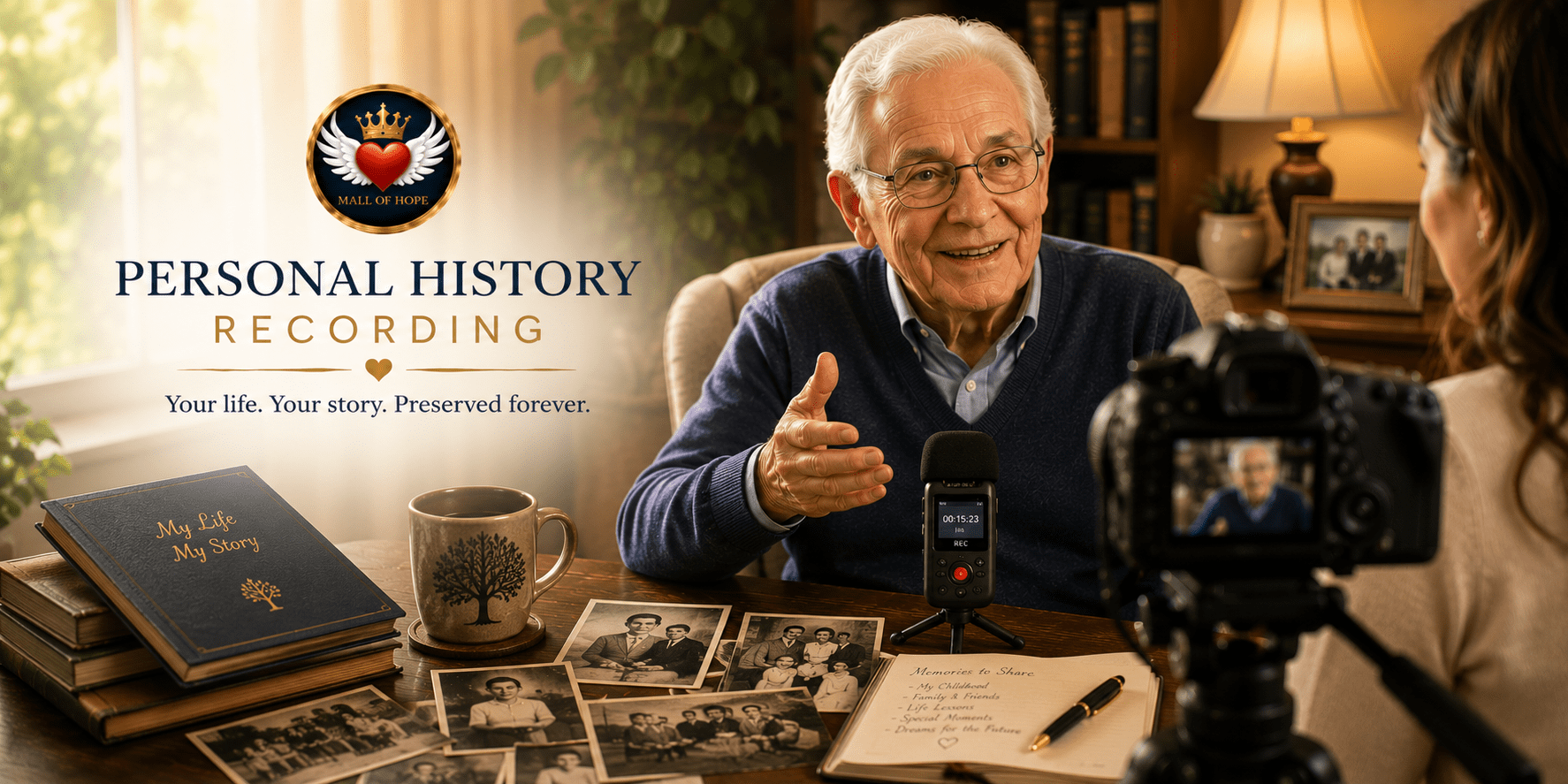

Every individual has a unique story that deserves to be preserved. Personal history recording is the intentional process of documenting a person’s memories, experiences, relationships, achievements, values, and life lessons through audio, video, written narratives, or digital archives. While official records document births, marriages, careers, and other milestones, they rarely capture the emotions, perspectives, wisdom, and personal experiences that define a person’s identity. Personal history recording ensures these irreplaceable memories are preserved before they fade with time.
Many people assume their life is too ordinary to be recorded, believing that only famous individuals or public figures leave meaningful legacies. In reality, family members often treasure the everyday stories of parents, grandparents, siblings, and loved ones more than any historical document. The memories of childhood, family traditions, military service, career experiences, faith, friendships, overcoming adversity, and lessons learned become invaluable gifts that strengthen family identity and connect generations.
Personal history recording has also become an essential component of person-centered dementia care. As memory-related conditions such as Alzheimer’s disease and other forms of dementia become increasingly common, preserving personal stories before cognitive changes progress helps maintain identity while providing valuable resources for caregivers and future generations. Research suggests that life review and reminiscence promote emotional well-being, strengthen identity, and encourage meaningful reflection throughout later life (Butler, 1963). Whether documenting an entire lifetime or capturing meaningful moments along the way, personal history recording preserves the essence of who someone is long after memories begin to change.
Why Personal History Recording Matters
Every family has stories that exist only in memory. These stories explain how previous generations lived, what they believed, the challenges they overcame, and the values they hoped to pass forward. Without intentional preservation, these memories often disappear within a single generation, leaving descendants with names and dates but little understanding of the people behind them.
Personal history recording transforms memories into permanent family resources. Rather than relying on fading recollections, future generations gain the opportunity to hear a loved one’s voice, observe their personality, and understand the experiences that shaped their life. Stories about growing up during difficult economic times, serving in the military, immigrating to a new country, raising children, building a business, practicing faith, or caring for aging parents become living lessons that continue inspiring future generations.
Research indicates that individuals who understand their family history often demonstrate stronger resilience, emotional well-being, and a greater sense of identity because they recognize themselves as part of an ongoing family narrative (Duke et al., 2008). Personal history recording strengthens these connections by preserving authentic stories rather than simply documenting historical facts.
Recording personal history also encourages reflection. Many individuals find that discussing important milestones allows them to recognize personal growth, appreciate meaningful relationships, and identify life lessons they hope others will remember. Butler (1963) described this process as life review, suggesting that reflecting upon one’s experiences contributes to emotional integration and psychological well-being during later adulthood.
Families also benefit from recording personal histories together. Conversations between parents, grandparents, children, and grandchildren frequently uncover forgotten stories while strengthening relationships in the present. These interviews become opportunities to ask meaningful questions that might otherwise remain unanswered.
Beyond individual families, personal history recording preserves community heritage. Veterans, teachers, healthcare professionals, business owners, artists, clergy, first responders, immigrants, and community leaders all contribute experiences that enrich local history while providing valuable firsthand perspectives on historical events and social change.
How to Record Your Personal History
Personal history recording is about preserving authenticity rather than creating a perfect production. Every story deserves to be told honestly, regardless of whether it is recorded professionally or with a smartphone at the kitchen table. What matters most is preserving the person’s voice, experiences, and perspective.
Preparation begins by deciding how the story will be organized. Some individuals prefer a chronological approach, beginning with childhood and progressing through adulthood. Others choose themes such as family traditions, education, military service, career achievements, marriage, parenting, community involvement, travel, faith, or lessons learned through adversity.
Creating a comfortable environment encourages natural conversation. Familiar surroundings, meaningful photographs, journals, family heirlooms, recipes, awards, military memorabilia, and favorite music often stimulate memory while making interviews more engaging. Recording sessions should allow sufficient time for thoughtful reflection without rushing responses.
Open-ended questions encourage storytelling instead of brief factual answers. Examples include:
- What are your earliest childhood memories?
- Who influenced your life the most?
- What challenges taught you the greatest lessons?
- What family traditions are most important to you?
- What accomplishments bring you the greatest pride?
- What advice would you like future generations to remember?
- What values have guided your decisions throughout life?
- How would you like your family to remember you?
Personal histories can be preserved in multiple formats. Audio recordings capture voices and emotional expression with minimal equipment. Video interviews preserve facial expressions, gestures, laughter, and personality that future generations often treasure. Written memoirs provide organized narratives suitable for publication or family archives. Digital storytelling platforms combine interviews with photographs, genealogy records, timelines, home movies, letters, and historical documents into comprehensive multimedia collections.
Whenever possible, recorded memories should be supported by historical documents such as photographs, military records, certificates, newspaper articles, family trees, and personal correspondence. Combining oral history with documentary evidence creates richer and more accurate family histories.
Personal History Recording and Person-Centered Dementia Care
Personal history recording plays a vital role in supporting individuals living with dementia by preserving identity before memory changes progress. Dementia affects cognitive function, but it does not erase the person’s life experiences, relationships, values, occupations, cultural heritage, or emotional needs. Person-centered care emphasizes understanding these qualities to provide compassionate and individualized support (Kitwood, 1997).
Recording personal histories shortly after a dementia diagnosis allows individuals to document their memories while communication abilities remain relatively strong. They can share childhood experiences, career accomplishments, military service, family traditions, spiritual beliefs, favorite hobbies, and hopes for future generations in their own words. These recordings become treasured family keepsakes while providing practical guidance for caregivers.
Professional caregivers benefit significantly from understanding an individual’s personal history. Knowing that someone spent decades as a teacher, musician, nurse, farmer, engineer, artist, or military veteran helps caregivers create meaningful conversations and activities that reinforce identity. Favorite songs, cherished recipes, beloved pets, travel experiences, and lifelong interests often become valuable tools for encouraging reminiscence while reducing anxiety.
Life story work has become an established component of person-centered dementia care because it encourages caregivers to see the individual beyond their diagnosis (Brooker, 2007). Memory books, recorded interviews, family photographs, legacy videos, and personal timelines support emotional connection while helping healthcare providers deliver individualized care.
Research suggests that reminiscence therapy may improve mood, communication, and overall quality of life for many individuals living with dementia (Woods et al., 2018). Personal history recordings contribute to these therapeutic approaches by providing authentic stories and familiar memories that remain meaningful throughout disease progression.
Families also find comfort in preserving personal histories before significant memory loss occurs. Hearing a loved one’s voice, seeing familiar expressions, and revisiting treasured memories provides reassurance while preserving emotional connection for children, grandchildren, and future descendants.
Creating a Lasting Legacy Through Personal History Recording
A personal history is one of the most valuable gifts a person can leave behind. Long after financial inheritances have been distributed and possessions have changed hands, personal stories continue teaching, inspiring, and connecting future generations. They preserve the character, wisdom, compassion, humor, and resilience that define a person’s true legacy.
Personal history recording complements genealogy by adding meaning to historical records. Family trees identify ancestors, while recorded stories explain who they were as individuals. Birth certificates, census records, military documents, and marriage licenses establish timelines, but personal narratives reveal motivations, emotions, traditions, and lived experiences that cannot be found in official archives.
Legacy preservation also includes documenting family traditions, recipes, religious practices, cultural customs, volunteer service, career accomplishments, parenting philosophies, favorite books, travel experiences, and reflections about life’s greatest lessons. These details enrich family identity while providing descendants with a deeper understanding of their heritage.
Long-term preservation requires careful planning. Digital recordings should be stored using secure cloud storage, external hard drives, and archival-quality backup systems. Files should be labeled clearly with names, dates, interview topics, and locations. Written transcripts improve accessibility and allow future family members to search interviews for names, events, or historical references.
Families should continue adding new stories over time. Recording milestones such as anniversaries, birthdays, retirements, reunions, military service, graduations, and family celebrations creates an evolving archive that grows with each generation. Personal history recording becomes not simply a project but a family tradition dedicated to preserving identity across generations.
Ultimately, every life contains experiences worth remembering. Whether documenting extraordinary accomplishments or celebrating the quiet influence of love, kindness, perseverance, and service, personal history recording honors the individual behind the memories. It ensures that future generations inherit more than names on a family tree—they inherit voices, wisdom, values, and stories that continue shaping their family long after one generation becomes the next.
Frequently Asked Questions
What is personal history recording?
Personal history recording is the process of preserving an individual’s memories, experiences, relationships, values, and life lessons through audio recordings, video interviews, written narratives, or digital archives.
How is personal history recording different from genealogy?
Genealogy documents family relationships using historical records, while personal history recording captures the stories, emotions, experiences, and perspectives that bring those records to life.
Why should I record my personal history before dementia develops?
Recording your history while memory remains strong preserves your voice, experiences, personality, and identity. These recordings become invaluable resources for family members and support person-centered dementia care if memory changes occur later.
What should be included in a personal history recording?
Topics often include childhood memories, family traditions, education, military service, career experiences, marriage, parenting, community involvement, faith, hobbies, life challenges, accomplishments, favorite memories, and advice for future generations.
How should personal history recordings be preserved?
Maintain multiple digital backups using secure cloud storage and external hard drives, create written transcripts, organize files with descriptive labels, and periodically update storage formats to ensure long-term accessibility for future generations.
References
Brooker, D. (2007). Person-centred dementia care: Making services better. Jessica Kingsley Publishers.
Butler, R. N. (1963). The life review: An interpretation of reminiscence in the aged. Psychiatry, 26(1), 65–76.
Duke, M. P., Lazarus, A., & Fivush, R. (2008). Knowledge of family history as a clinically useful index of psychological well-being and prognosis. Journal of Family Life, 7(2), 133–140.
Kitwood, T. (1997). Dementia reconsidered: The person comes first. Open University Press.
McAdams, D. P. (2008). Personal narratives and the life story. In O. P. John, R. W. Robins, & L. A. Pervin (Eds.), Handbook of personality: Theory and research (3rd ed., pp. 242–262). Guilford Press.
National Institute on Aging. (2024). Alzheimer’s disease fact sheet. https://www.nia.nih.gov/health/alzheimers-and-dementia/alzheimers-disease-fact-sheet
Woods, B., O’Philbin, L., Farrell, E. M., Spector, A., & Orrell, M. (2018). Reminiscence therapy for dementia. Cochrane Database of Systematic Reviews, 3, CD001120.
World Health Organization. (2023). Dementia. https://www.who.int/news-room/fact-sheets/detail/dementia