
Every grandparent holds a lifetime of experiences that no one else can fully tell. They remember family traditions, historical events, childhood adventures, first loves, careers, raising children, moments of hardship, and lessons learned over decades of life. Unfortunately, many of these stories disappear simply because no one asked the right questions. Taking the time to discover the best questions to ask grandparents is one of the most meaningful ways to preserve family history, strengthen relationships, and create a lasting legacy for future generations.
Grandparents provide much more than historical information. They offer wisdom, perspective, resilience, humor, faith, traditions, and values that help younger generations better understand both their family history and themselves. Through thoughtful conversations, professional life story interviews, legacy videos, memoirs, audio recordings, and digital family archives, these memories can be preserved long after the conversations have ended.
Research has shown that individuals who know more about their family history often demonstrate greater resilience, stronger emotional well-being, and a deeper sense of identity because they understand themselves as part of a continuing family narrative (Duke et al., 2008). Recording grandparents’ stories strengthens this connection while ensuring that future generations inherit not only names and dates but also the experiences that shaped their family.
These conversations become even more important as grandparents age. Memory changes associated with Alzheimer’s disease and other forms of dementia may gradually affect communication, making early recording especially valuable. Life review has been shown to support emotional well-being by helping older adults reflect upon their experiences and recognize meaning throughout their lives (Butler, 1963). Person-centered care also recognizes that understanding an individual’s personal history supports dignity, compassionate caregiving, and meaningful relationships (Fazio et al., 2018).
Whether you are interviewing grandparents for a school project, creating a family history book, producing a legacy video, or simply spending meaningful time together, asking thoughtful questions today creates memories your family will treasure forever.
Why Asking Grandparents Questions Matters
Every family has stories that risk disappearing unless someone intentionally preserves them. Grandparents often possess memories that span generations, connecting today’s children with great-grandparents and ancestors they never had the opportunity to meet.
Simple conversations frequently uncover remarkable stories about:
- Childhood during historical events
- Immigration journeys
- Military service
- Family traditions
- Courtship and marriage
- Raising children
- Career experiences
- Community involvement
- Faith and personal beliefs
- Lessons learned through adversity
Many grandparents assume these stories are ordinary because they lived them. However, what feels ordinary to them often becomes extraordinary family history for future generations.
Meaningful interviews also strengthen family relationships. Adult children and grandchildren frequently discover aspects of their grandparents’ lives they never previously understood, creating deeper appreciation and emotional connection.
Recording these conversations preserves something photographs alone cannot—voice, laughter, personality, emotion, and authentic storytelling. Future generations are able to hear family history directly from those who experienced it.
Perhaps most importantly, asking thoughtful questions communicates respect. It tells grandparents that their experiences matter and that their wisdom deserves to be remembered.
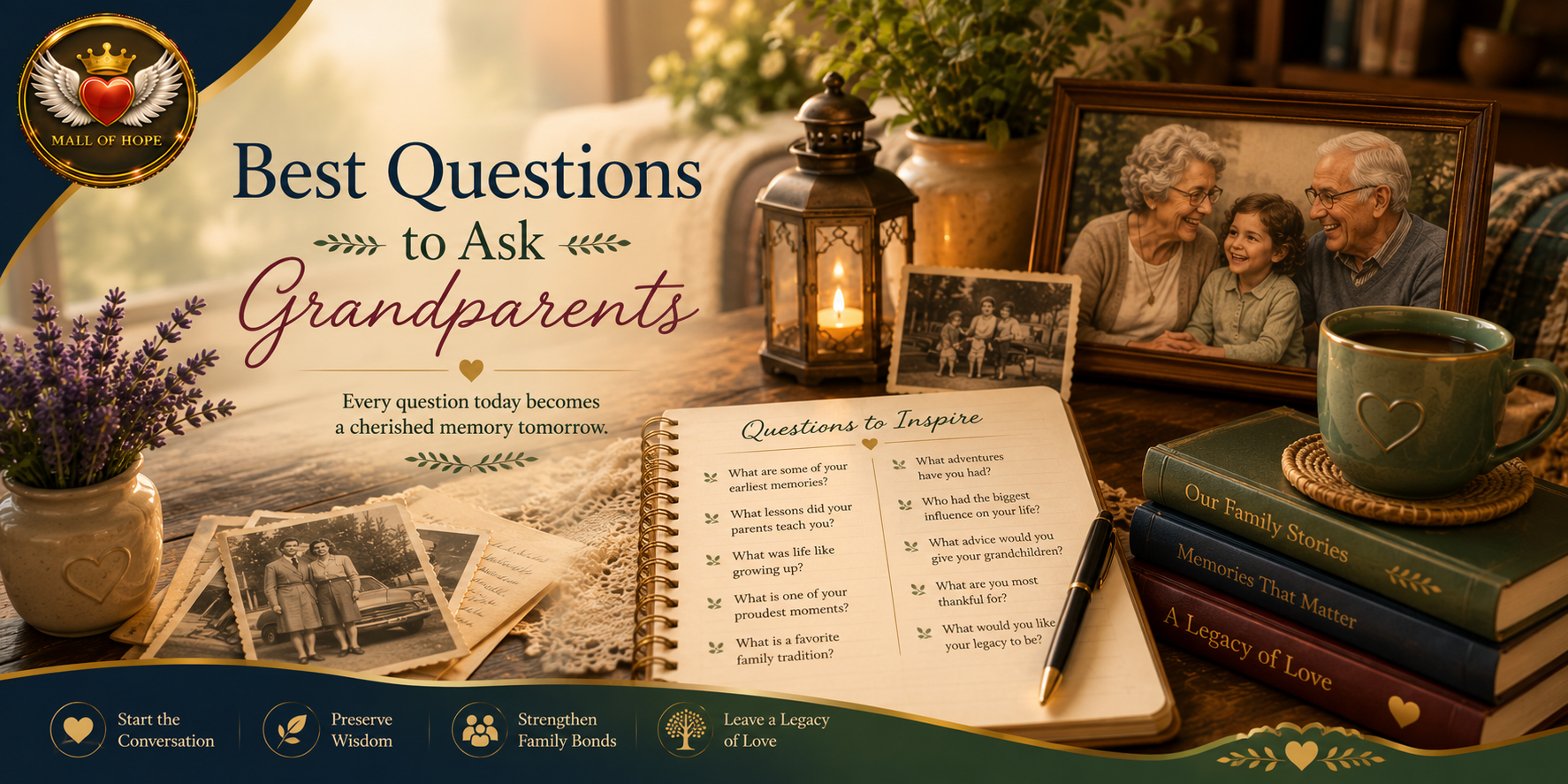
The Best Questions to Ask Grandparents
Open-ended questions encourage storytelling rather than short answers. Instead of asking questions that can be answered with “yes” or “no,” invite grandparents to describe experiences, emotions, and lessons they learned throughout life.
Childhood and Family
- What was your childhood home like?
- What games did you enjoy playing?
- Who were your closest friends?
- What are your happiest childhood memories?
- What traditions did your family celebrate?
- What were your parents and grandparents like?
- What chores did you have growing up?
- What did you dream of becoming as a child?
School and Early Adulthood
- What was school like when you were young?
- Who inspired you the most?
- What was your first job?
- How did you spend your free time?
- What was dating like when you were younger?
- What music did you enjoy?
- What major historical events do you remember?
Marriage and Family
- How did you meet Grandma or Grandpa?
- What was your wedding day like?
- What was it like raising children?
- Which family traditions are most important?
- What vacations or holidays stand out the most?
- What family memories make you smile today?
Career and Life Lessons
- What career accomplishments are you most proud of?
- What was the biggest challenge you faced?
- How did you overcome difficult times?
- What decisions changed your life?
- What advice would you give your younger self?
- What lessons did life teach you?
Values and Legacy
- What values do you hope our family continues?
- What does success mean to you?
- What are you most grateful for?
- What advice would you give your grandchildren?
- What do you hope people remember about you?
- If you could leave one message for future generations, what would it be?
These questions often lead naturally into additional conversations, allowing grandparents to remember details they may not have considered for years.
Recording Grandparents’ Stories Before Memories Fade
While every family hopes there will always be more time, memories naturally change with age. Recording conversations early ensures that stories remain accurate, detailed, and personally meaningful.
For families affected by Alzheimer’s disease or other forms of dementia, early interviews become especially valuable. Although dementia gradually affects memory and communication, recording life stories while communication remains relatively strong preserves identity, relationships, and personal history before those memories become more difficult to express.
Person-centered dementia care emphasizes understanding the individual beyond medical diagnoses (Kitwood, 1997). Life story interviews provide caregivers with valuable insight into occupations, hobbies, military service, cultural traditions, family relationships, faith, favorite activities, and lifelong interests.
Research supports life story work and reminiscence as evidence-based interventions that may improve communication, emotional well-being, and quality of life for many people living with dementia (Woods et al., 2018). Family photographs, recorded interviews, favorite music, and memory books often become meaningful tools that encourage conversation while reinforcing personal identity.
Families are encouraged to begin recording grandparents’ stories soon after a diagnosis of mild cognitive impairment or early-stage dementia. Waiting too long may result in the loss of stories that only grandparents can tell.
Professional life story interviews also remove much of the pressure from family members by providing experienced interviewers who know how to ask thoughtful questions while creating a relaxed, enjoyable conversation.
Turning Conversations into a Lasting Family Legacy
Asking meaningful questions is only the beginning. Preserving those conversations ensures that future generations can continue learning from grandparents long after the interview has ended.
Many families transform these interviews into comprehensive legacy collections that include professional life story videos, written memoirs, audio recordings, genealogy research, family history books, memory books, photographs, scanned letters, family recipes, journals, and secure digital archives. Together, these materials preserve both family history and the personality that brings those stories to life.
Modern technology makes preservation easier than ever. High-definition video, searchable transcripts, encrypted cloud storage, external hard drives, and digital family archives help protect these irreplaceable conversations while allowing relatives around the world to access them. Maintaining multiple backups and organizing files with names, dates, and descriptions further strengthens long-term preservation.
Families can also make storytelling an ongoing tradition by recording interviews during birthdays, anniversaries, holidays, reunions, or other milestone celebrations. As new generations grow, they can continue adding their own stories, creating a living archive that reflects the family’s continuing journey.
Ultimately, the best questions to ask grandparents are the ones that communicate curiosity, appreciation, and love. Every answer preserves more than information—it preserves identity, wisdom, resilience, humor, traditions, and values. Long after the conversations have ended, future generations will still be able to hear familiar voices, understand where they came from, and discover the remarkable stories that shaped their family. By asking these questions today, you create a priceless legacy that will continue inspiring your family for generations to come.
Frequently Asked Questions
What are the best questions to ask grandparents?
The best questions are open-ended and explore childhood memories, family traditions, marriage, careers, life lessons, historical events, faith, values, accomplishments, and advice for future generations.
Why is it important to interview grandparents?
Interviewing grandparents preserves family history, strengthens relationships, captures personal stories before they are lost, and creates a lasting legacy that future generations can continue learning from.
When should I record my grandparents’ stories?
The best time is as soon as possible. Recording stories while grandparents are healthy and able to communicate comfortably helps preserve detailed memories before age-related health or memory changes occur.
How do life story interviews help families affected by dementia?
Recording stories before dementia progresses preserves identity, supports person-centered care, provides opportunities for reminiscence, and helps caregivers better understand the individual’s life history and preferences.
What is the best way to preserve my grandparents’ stories?
Many families preserve stories through professional life story interviews, legacy videos, written memoirs, audio recordings, memory books, genealogy projects, and secure digital archives with multiple backups.
References
Butler, R. N. (1963). The life review: An interpretation of reminiscence in the aged. Psychiatry, 26(1), 65–76.
Duke, M. P., Lazarus, A., & Fivush, R. (2008). Knowledge of family history as a clinically useful index of psychological well-being and prognosis. Journal of Family Life, 7(2), 133–140.
Fazio, S., Pace, D., Flinner, J., & Kallmyer, B. (2018). The fundamentals of person-centered care for individuals with dementia. The Gerontologist, 58(Suppl. 1), S10–S19.
Kitwood, T. (1997). Dementia reconsidered: The person comes first. Open University Press.
McAdams, D. P. (2008). Personal narratives and the life story. In O. P. John, R. W. Robins, & R. A. Pervin (Eds.), Handbook of personality: Theory and research (3rd ed., pp. 242–262). Guilford Press.
Woods, B., O’Philbin, L., Farrell, E. M., Spector, A., & Orrell, M. (2018). Reminiscence therapy for dementia. Cochrane Database of Systematic Reviews, 3, CD001120.
World Health Organization. (2023). Dementia. https://www.who.int/news-room/fact-sheets/detail/dementia