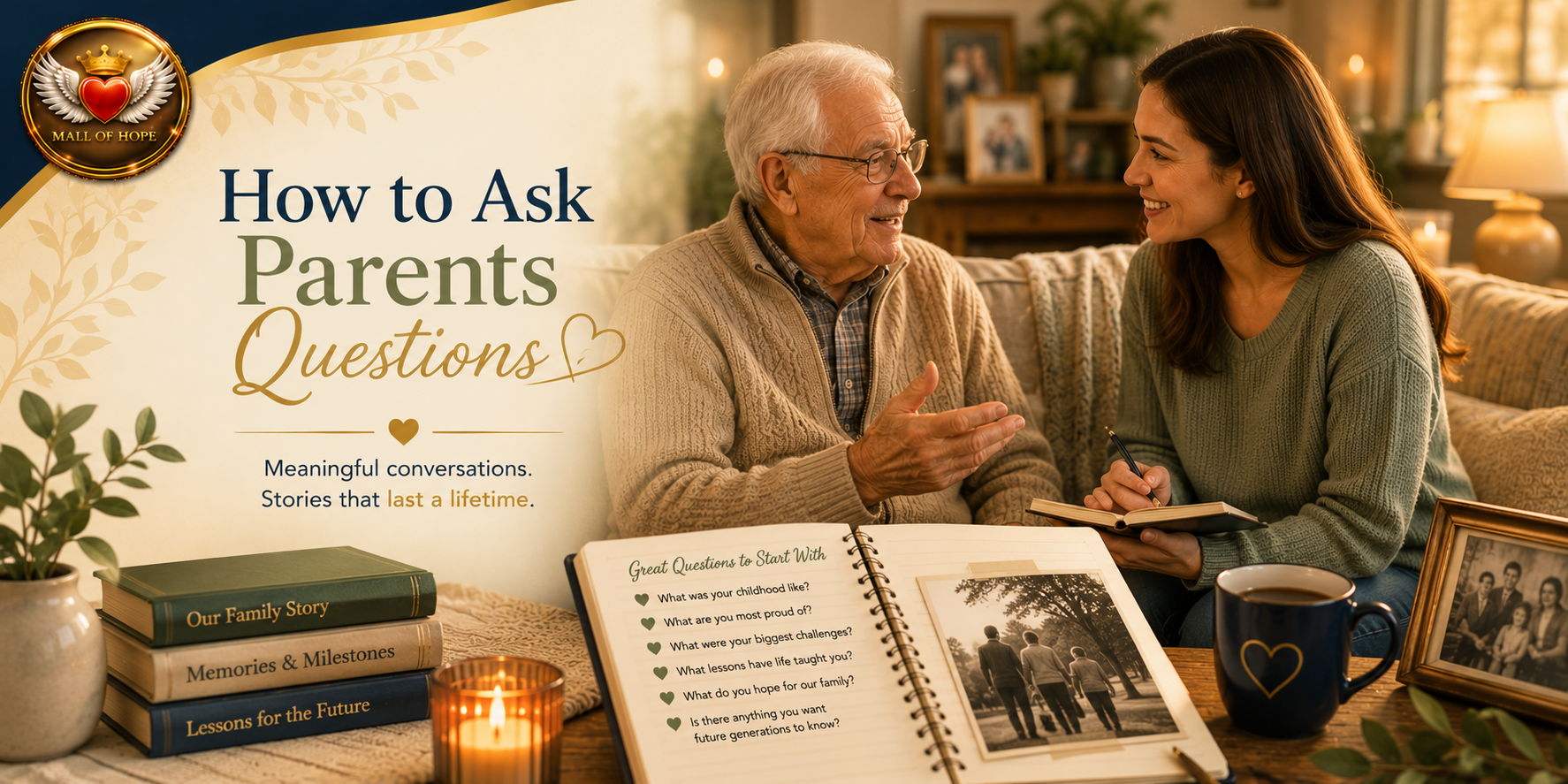

Every parent carries a lifetime of experiences that have shaped not only their own life but also the lives of their children and future generations. Their memories include stories about childhood, family traditions, love, sacrifice, careers, historical events, friendships, faith, and the lessons they learned through decades of living. Yet many families discover too late that they never asked the questions that would have preserved those priceless memories. Learning how to ask parents questions is one of the most meaningful ways to preserve family history while strengthening relationships and creating a lasting legacy.
Many adult children assume they already know their parents’ stories because they have lived together for years. However, parents often share only small pieces of their lives during everyday conversations. There are usually untold stories about grandparents, childhood adventures, military service, immigration, career challenges, personal struggles, acts of kindness, and life-changing decisions that have never been discussed. These memories often disappear if they are not intentionally recorded.
As parents grow older, preserving these stories becomes increasingly important. According to the World Health Organization (2023), dementia affects more than 55 million people worldwide, making early conversations about personal history especially valuable. Recording memories before significant cognitive changes occur helps preserve identity while providing future generations with authentic family history. Research suggests that life review promotes emotional well-being, reinforces identity, and supports psychological integration throughout later adulthood (Butler, 1963).
Whether your goal is to create a family history, record a legacy interview, write a memoir, develop a genealogy project, or simply spend meaningful time together, asking thoughtful questions allows parents to share the experiences that shaped their lives while creating memories that will be treasured for generations.
Why Asking Your Parents Questions Matters
Many families inherit photographs, certificates, military records, heirlooms, recipes, and family trees, but never learn the stories behind them. A photograph may show smiling faces, yet without conversation, future generations may never know who those people were, what they believed, or how they influenced the family’s history.
Asking thoughtful questions allows parents to explain the meaning behind important life events. Stories about childhood homes, first jobs, marriage, raising children, community involvement, faith, travel, and personal challenges create a much richer understanding of family identity than names and dates alone.
Research has shown that individuals who know more about their family history often demonstrate greater resilience, stronger emotional well-being, and a deeper sense of identity because they understand themselves as part of an ongoing family narrative (Duke et al., 2008). Parents are often the most important storytellers in preserving that narrative.
These conversations also strengthen family relationships. Asking genuine questions communicates respect, curiosity, and appreciation. Many parents feel honored that their children want to understand their experiences, while adult children frequently discover shared values, unexpected similarities, and inspiring stories they had never heard before.
The interview process itself often becomes a treasured memory. Sitting together, looking through photographs, sharing laughter, remembering loved ones, and reflecting on life’s journey creates meaningful moments that strengthen family bonds long before the final recording or written story is completed.
The Best Questions to Ask Your Parents
The best conversations begin with open-ended questions that invite storytelling rather than simple yes-or-no answers. Instead of focusing only on important dates, encourage parents to describe emotions, relationships, challenges, and life lessons.
Some of the most meaningful topics include:
- Childhood memories and favorite family traditions
- Stories about parents and grandparents
- School experiences and lifelong friendships
- First jobs and career experiences
- Military service or historical events they witnessed
- How they met their spouse or partner
- Raising children and favorite parenting memories
- Faith, spirituality, and personal beliefs
- Family recipes, holiday traditions, and celebrations
- Life’s greatest challenges and proudest accomplishments
- Lessons they wish they had learned earlier
- Advice for children, grandchildren, and future generations
Follow-up questions often reveal the richest stories. If your parent mentions a particular person, place, or event, gently ask them to tell you more about it. Questions like “How did that make you feel?” or “What happened next?” often encourage deeper reflection.
Many families find it helpful to use photographs, family heirlooms, newspaper clippings, recipes, letters, military medals, or old home movies during conversations. These items frequently trigger memories that might otherwise remain forgotten.
Recording interviews through video or audio allows future generations to experience not only the stories themselves but also the parent’s voice, laughter, facial expressions, and personality.
Creating Comfortable and Meaningful Conversations
The way questions are asked can be just as important as the questions themselves. Parents are often more willing to share personal memories when conversations feel relaxed, respectful, and unhurried.
Choose a quiet environment where interruptions are limited and allow plenty of time so the conversation never feels rushed. Rather than trying to complete an entire life story in one sitting, consider recording several shorter conversations over weeks or months.
Listen more than you speak. Allow pauses, avoid interrupting, and resist the urge to immediately move to the next question. Some of the most meaningful stories emerge after a few moments of quiet reflection.
It is also important to respect emotional boundaries. Certain topics may involve grief, trauma, or difficult family experiences. If a parent appears uncomfortable, allow them to decide how much they wish to share. Compassionate listening builds trust and often leads to deeper conversations over time.
For families affected by dementia, beginning these conversations early is especially valuable. Recording memories during the early stages of mild cognitive impairment or Alzheimer’s disease helps preserve detailed stories while communication remains relatively strong. Person-centered dementia care emphasizes understanding the individual’s life story because it supports identity, improves communication, and guides individualized care (Kitwood, 1997).
Research also supports life story work and reminiscence as evidence-based approaches that may improve communication, emotional well-being, and quality of life for individuals living with dementia (Woods et al., 2018).
Preserving Your Parents’ Stories for Future Generations
Asking meaningful questions is only the beginning. Preserving the answers ensures that future generations can continue learning from your parents long after today’s conversations have ended.
Many families combine interviews with broader legacy preservation projects that include:
- Professionally recorded life story interviews
- Legacy videos and documentaries
- Written autobiographies and memoirs
- Family history books
- Memory books with photographs
- Genealogy research and family trees
- Digitized letters, journals, recipes, and certificates
- Secure digital archives containing interviews, videos, and photographs
Digital preservation has made it easier than ever to organize family history. Multiple secure backups using encrypted cloud storage and external hard drives help protect these valuable memories while ensuring they remain accessible for future generations.
These conversations should also become an ongoing family tradition rather than a one-time interview. Birthdays, anniversaries, holidays, reunions, and milestone celebrations provide wonderful opportunities to record additional stories and preserve new reflections as life continues.
Ultimately, asking your parents meaningful questions is one of the greatest gifts you can give your family. It preserves more than facts—it preserves identity, wisdom, humor, resilience, traditions, values, and love. Long after photographs have faded and memories have changed, future generations will still be able to understand the people who shaped their family through the stories told in your parents’ own words. Every conversation today becomes tomorrow’s family history.
Frequently Asked Questions
When is the best time to ask my parents about their life story?
The best time is now. Recording conversations while your parents are healthy and comfortable sharing memories helps preserve detailed stories, emotions, and personal experiences before age or illness affects communication.
What questions should I ask my parents first?
Begin with easy, open-ended questions about childhood, family traditions, favorite memories, school, friendships, careers, marriage, and life lessons before moving into more personal or emotional topics.
Should I record the conversation?
Yes. Audio or video recordings preserve your parent’s voice, expressions, personality, and storytelling style, creating a more meaningful legacy for future generations.
How can these conversations help families affected by dementia?
Recording memories early preserves identity, family history, and personal experiences before dementia progresses. These stories also support person-centered care by helping caregivers understand the individual’s background, values, and preferences.
What is the best way to preserve my parents’ stories?
Many families combine recorded interviews with written memoirs, memory books, genealogy research, photographs, legacy videos, and secure digital archives to create a comprehensive family history that can be shared across generations.
References
Butler, R. N. (1963). The life review: An interpretation of reminiscence in the aged. Psychiatry, 26(1), 65–76.
Duke, M. P., Lazarus, A., & Fivush, R. (2008). Knowledge of family history as a clinically useful index of psychological well-being and prognosis. Journal of Family Life, 7(2), 133–140.
Fazio, S., Pace, D., Flinner, J., & Kallmyer, B. (2018). The fundamentals of person-centered care for individuals with dementia. The Gerontologist, 58(Suppl. 1), S10–S19.
Kitwood, T. (1997). Dementia reconsidered: The person comes first. Open University Press.
McAdams, D. P. (2008). Personal narratives and the life story. In O. P. John, R. W. Robins, & L. A. Pervin (Eds.), Handbook of Personality: Theory and Research (3rd ed., pp. 242–262). Guilford Press.
National Institute on Aging. (2024). Caring for a person with Alzheimer’s disease. https://www.nia.nih.gov/health/alzheimers-and-dementia/caring-person-alzheimers-disease
Woods, B., O’Philbin, L., Farrell, E. M., Spector, A., & Orrell, M. (2018). Reminiscence therapy for dementia. Cochrane Database of Systematic Reviews, 3, CD001120.
World Health Organization. (2023). Dementia. https://www.who.int/news-room/fact-sheets/detail/dementia