
When people think about leaving a legacy, they often think about financial inheritances, property, or treasured possessions. While these gifts certainly have value, many families discover that the most meaningful inheritance is something far more personal-a preserved life story, a heartfelt letter, a recorded voice, a family recipe, or a legacy video that allows future generations to know the people who came before them. The best legacy gift ideas are those that preserve identity, strengthen family relationships, and ensure memories, wisdom, and values continue inspiring children and grandchildren for generations.
Unlike traditional gifts that may eventually wear out or lose significance, legacy gifts grow more valuable over time. A professionally recorded life story becomes increasingly precious decades after it is created. A grandparent’s voice recording comforts future generations. A family history book answers questions children never had the opportunity to ask. These gifts preserve not only memories but also personality, laughter, character, and love.
Modern technology has expanded the possibilities for creating lasting legacy gifts. Professional life story interviews, legacy documentaries, digital memory archives, autobiography recordings, genealogy projects, memoirs, family keepsake books, and heirloom videos allow families to preserve voices, photographs, stories, and historical records together in one meaningful collection. Rather than leaving future generations with unanswered questions, these projects create enduring family treasures that continue educating and inspiring long into the future.
Legacy gifts also play an important role in healthy aging and dementia care. Recording life stories while communication remains strong helps preserve personal identity before Alzheimer’s disease or other forms of dementia affect memory. Research suggests that life review promotes emotional well-being by helping older adults reflect on their experiences and recognize meaning throughout their lives (Butler, 1963). Person-centered care likewise emphasizes understanding an individual’s personal history because doing so supports dignity, compassionate caregiving, and stronger relationships (Fazio et al., 2018).
Whether you are searching for a meaningful gift for parents, grandparents, newly retired loved ones, or someone celebrating a milestone birthday, a legacy gift creates something that no store can sell—a lasting connection between generations.
Why Legacy Gifts Matter More Than Material Possessions
Many traditional gifts bring temporary enjoyment, but legacy gifts preserve something irreplaceable: the story of a person’s life. Families often inherit jewelry, furniture, photographs, or heirlooms without knowing the history behind them. A watch may have belonged to a grandfather, but future generations may never learn why it mattered or the experiences it witnessed.
Legacy gifts preserve those missing stories. They explain where a family came from, what values shaped previous generations, how challenges were overcome, and what wisdom parents and grandparents hoped to pass forward.
Research demonstrates that people who know more about their family history often develop greater resilience, emotional well-being, and a stronger sense of identity because they understand themselves as part of an ongoing family narrative (Duke et al., 2008). Legacy gifts strengthen that narrative by preserving firsthand stories that cannot be replaced once they are lost.
They also create opportunities for meaningful conversations. Giving a parent or grandparent a life story interview encourages questions families may never have asked before. Recording memories often strengthens relationships while providing emotional fulfillment for both the storyteller and those listening.
Unlike material possessions that may eventually become outdated or forgotten, preserved stories become increasingly valuable as children grow older, grandchildren mature, and future generations seek to understand their family’s history.
Ultimately, legacy gifts remind families that the greatest inheritance often consists not of what someone owned, but of who they were.
Meaningful Legacy Gift Ideas for Every Family
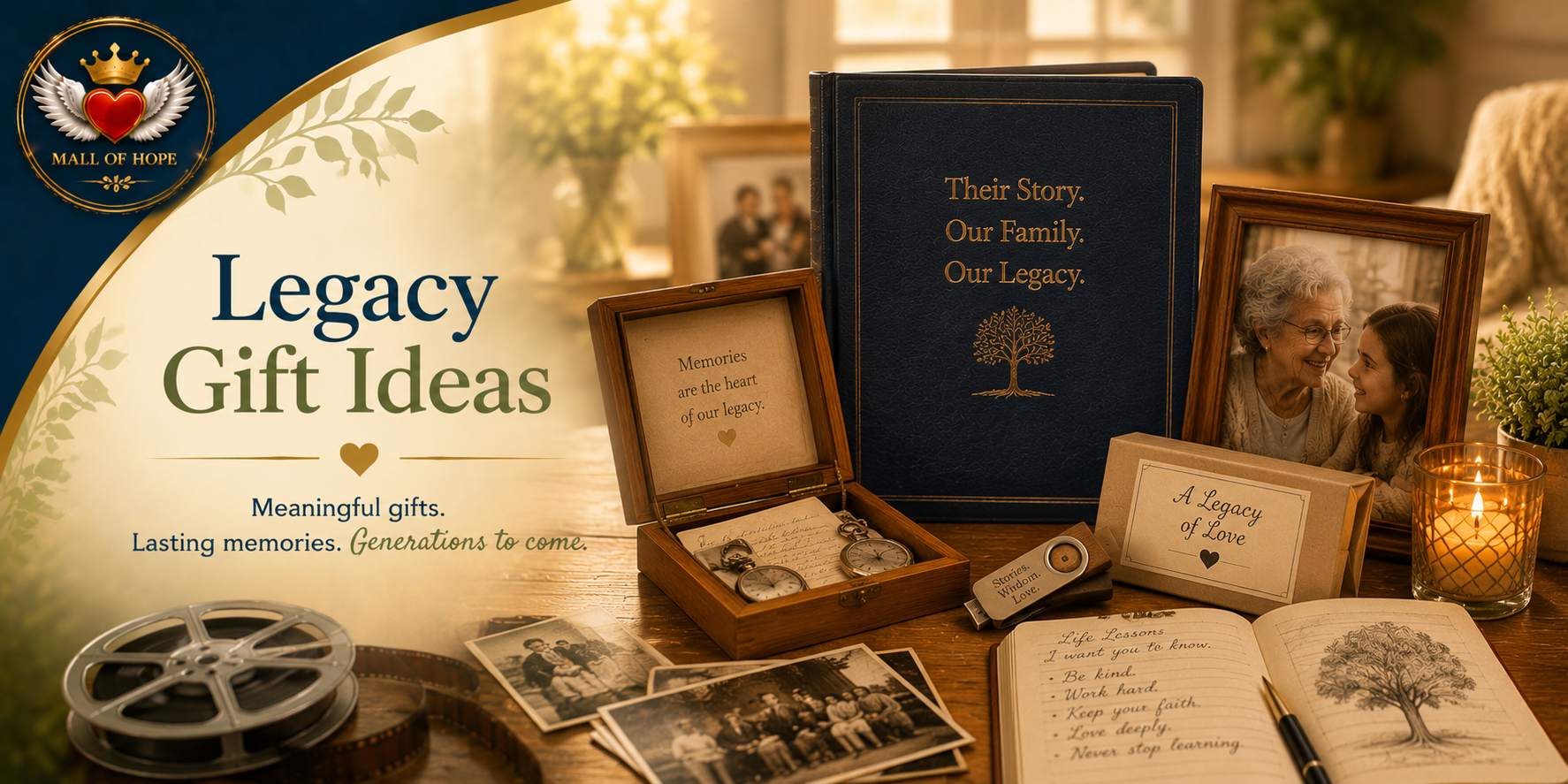
The most meaningful legacy gifts preserve memories, relationships, wisdom, and identity rather than simply commemorating an occasion. Many of these projects can be personalized to reflect the recipient’s personality, interests, and family history.
Popular legacy gift ideas include:
- Professional life story interviews
- Legacy videos or documentary films
- Video biographies
- Family history books
- Written memoirs or autobiographies
- Voice recordings for children and grandchildren
- Memory books filled with photographs and stories
- Family recipe collections with personal memories
- Genealogy research and family trees
- Digitized photographs and home movies
- Handwritten letters for future milestones
- Ethical wills that preserve values and life lessons
- Legacy journals
- Audio memoirs
- Family archive collections
- Grandparent interview books
- Digital memory collections
- Time capsules for future generations
Among the most meaningful gifts is a professionally recorded life story interview. Unlike a simple photograph or written card, an interview captures voice, facial expressions, humor, emotion, and authentic storytelling while preserving decades of personal experiences.
Families often enhance these projects by including treasured photographs, military records, family heirlooms, recipes, journals, certificates, newspaper articles, travel memorabilia, and historical documents. Together, these materials create a comprehensive family legacy that preserves both history and identity.
These gifts are particularly meaningful for milestone birthdays, anniversaries, retirements, Mother’s Day, Father’s Day, Christmas, weddings, family reunions, or celebrations honoring parents and grandparents.
Legacy Gifts for Aging Parents and Grandparents
One of the greatest opportunities to create a meaningful legacy gift is while parents and grandparents are still able to share their memories personally. Too often, families postpone these conversations until illness or memory changes make storytelling more difficult.
Older adults frequently enjoy reflecting on childhood, careers, marriage, parenting, military service, community involvement, faith, and the lessons they have learned throughout life. Recording these memories preserves not only family history but also personality, humor, values, and wisdom.
For families affected by Alzheimer’s disease or other forms of dementia, beginning legacy projects early is especially important. Recording life stories while communication remains relatively strong protects memories before cognitive changes become more significant.
Person-centered care emphasizes understanding an individual’s life history beyond medical diagnoses (Kitwood, 1997). Legacy gifts such as life story interviews, memory books, and family archives provide caregivers with valuable insight into personal values, occupations, hobbies, cultural traditions, favorite activities, family relationships, and meaningful experiences.
Research supports life story work and reminiscence as evidence-based interventions that may improve communication, emotional well-being, and quality of life for many individuals living with dementia (Woods et al., 2018). Legacy gifts therefore serve not only as family treasures but also as practical caregiving resources that strengthen person-centered care.
Parents and grandparents are often surprised to discover how interested younger generations are in their stories. Recording those conversations creates meaningful experiences today while preserving irreplaceable memories for tomorrow.
Creating a Legacy Gift That Lasts for Generations
The most successful legacy gifts are designed with long-term preservation in mind. A recorded interview, memoir, or family archive should remain accessible decades into the future, allowing children, grandchildren, and future descendants to continue exploring their family’s history.
Digital preservation plays an important role in protecting these resources. Families should maintain multiple backups using encrypted cloud storage, external hard drives, and offline archival copies stored separately. Original photographs, journals, letters, and heirlooms should also be preserved using archival-quality materials to minimize deterioration over time.
Many families create comprehensive legacy collections that combine professional life story interviews, heirloom videos, genealogy research, memoirs, photographs, audio recordings, memory books, journals, scanned documents, and digital family archives. Together, these resources preserve not only factual history but also the emotions, relationships, and experiences that shaped each generation.
Legacy gifts should also continue evolving over time. Recording annual family interviews, documenting milestone birthdays, preserving holiday traditions, updating genealogy research, and encouraging younger generations to contribute their own stories creates a living archive that grows alongside the family itself.
Ultimately, the greatest legacy gifts are not measured by their monetary value but by their ability to preserve love, wisdom, resilience, humor, faith, and identity. They remind future generations that every ordinary life contains extraordinary stories worth remembering. By giving a legacy gift today, you create an enduring inheritance that will continue educating, inspiring, comforting, and connecting your family for generations to come.
Frequently Asked Questions
What is a legacy gift?
A legacy gift is a meaningful project or keepsake that preserves a person’s life story, memories, wisdom, values, voice, or family history so future generations can continue learning from and connecting with them.
What are some meaningful legacy gift ideas?
Popular legacy gifts include professional life story interviews, legacy videos, memoirs, family history books, genealogy research, voice recordings, memory books, digital archives, handwritten letters, and family recipe collections.
Who are legacy gifts best suited for?
Legacy gifts are ideal for parents, grandparents, retirees, older adults, milestone birthdays, anniversaries, weddings, holidays, and anyone who wants to preserve their personal story and family history.
Why are legacy gifts important for families affected by dementia?
Recording memories before dementia progresses helps preserve personal identity, family history, values, and life lessons while supporting person-centered care and strengthening future family connections.
How can I preserve a legacy gift for future generations?
Maintain multiple digital backups, organize files with names and dates, create written transcripts of interviews, use archival-quality storage for physical materials, and update digital storage methods as technology evolves.
References
Brooker, D. (2007). Person-centred dementia care: Making services better. Jessica Kingsley Publishers.
Butler, R. N. (1963). The life review: An interpretation of reminiscence in the aged. Psychiatry, 26(1), 65–76.
Duke, M. P., Lazarus, A., & Fivush, R. (2008). Knowledge of family history as a clinically useful index of psychological well-being and prognosis. Journal of Family Life, 7(2), 133–140.
Fazio, S., Pace, D., Flinner, J., & Kallmyer, B. (2018). The fundamentals of person-centered care for individuals with dementia. The Gerontologist, 58(Suppl. 1), S10–S19.
Kitwood, T. (1997). Dementia reconsidered: The person comes first. Open University Press.
McAdams, D. P. (2008). Personal narratives and the life story. In O. P. John, R. W. Robins, & L. A. Pervin (Eds.), Handbook of personality: Theory and research (3rd ed., pp. 242–262). Guilford Press.
Woods, B., O’Philbin, L., Farrell, E. M., Spector, A., & Orrell, M. (2018). Reminiscence therapy for dementia. Cochrane Database of Systematic Reviews, 3, CD001120.
World Health Organization. (2023). Dementia. https://www.who.int/news-room/fact-sheets/detail/dementia