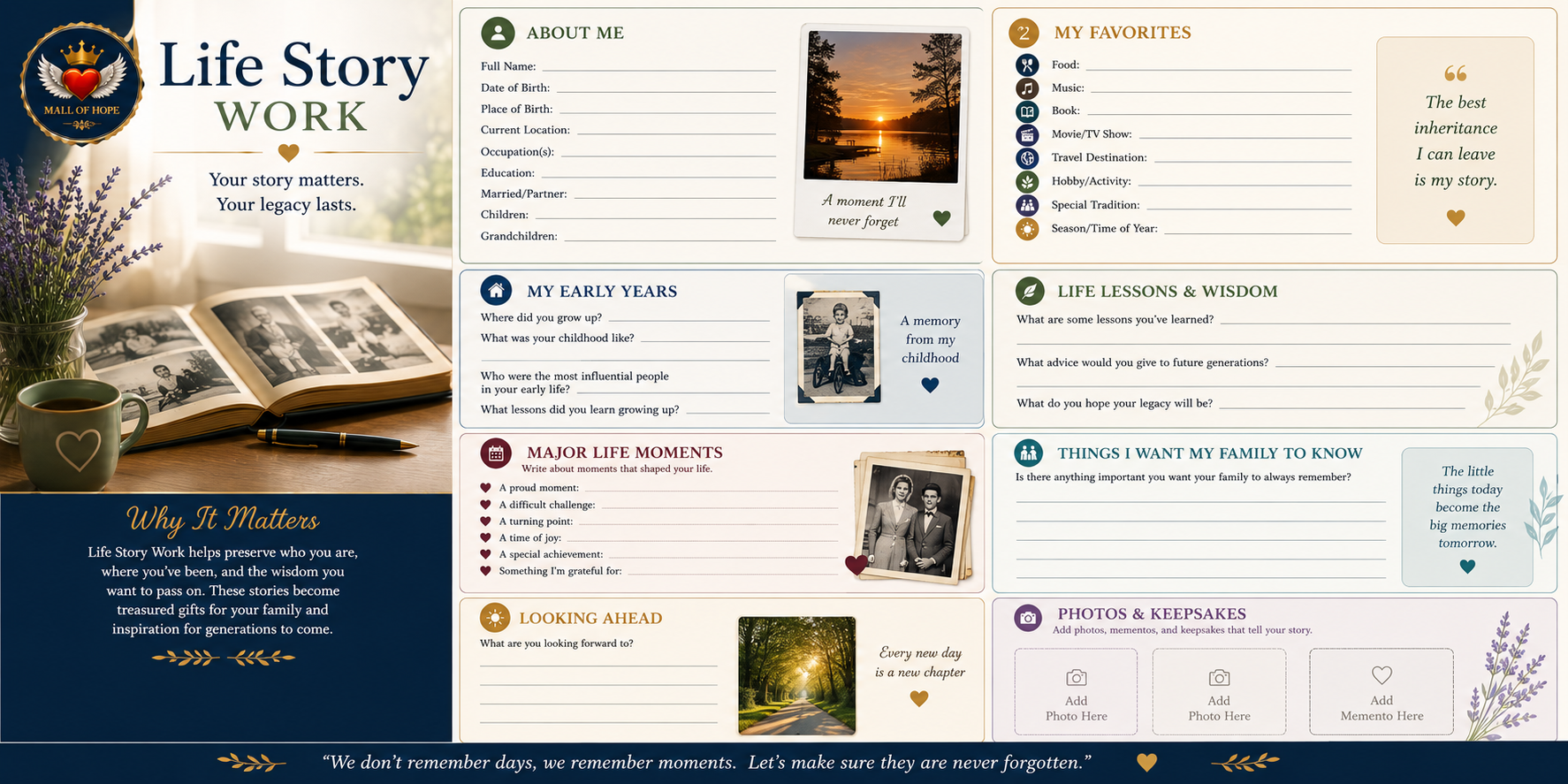

Every person’s life is made up of experiences, relationships, achievements, traditions, and memories that shape who they are. While medical records may describe diagnoses and treatments, they rarely capture the values, personality, beliefs, passions, and life experiences that define an individual. Life story work is a person-centered approach that documents these experiences, helping families and caregivers understand the whole person rather than focusing solely on illness or aging.
Originally developed within dementia care, life story work has become an internationally recognized practice that supports identity, communication, emotional well-being, and individualized care. Through interviews, photographs, written memories, family histories, videos, memory books, and digital storytelling, individuals can preserve their personal narratives while creating meaningful resources for both caregivers and future generations.
Life story work is valuable for people of all ages, but it becomes especially important when someone is living with Alzheimer’s disease or another form of dementia. As memory and communication change over time, a recorded life story helps preserve identity, supports meaningful conversations, and provides caregivers with practical information about the person’s background, preferences, relationships, and values. Rather than asking, “What disease does this person have?” life story work encourages caregivers to ask, “Who is this person, and what has shaped their life?”
Research has consistently shown that person-centered approaches improve the quality of dementia care by recognizing individuality, promoting dignity, and strengthening relationships (Kitwood, 1997). Life review and reminiscence also contribute to emotional well-being and psychological integration throughout later adulthood (Butler, 1963). Today, life story work is widely used in hospitals, home care, assisted living communities, memory care facilities, hospice programs, and family caregiving because it preserves what matters most—identity.
Whether you are documenting your own experiences, preserving the memories of a parent or grandparent, or supporting someone living with dementia, life story work creates a lasting legacy that benefits both current caregivers and future generations.
What Is Life Story Work?
Life story work is the structured process of collecting, organizing, and preserving an individual’s personal history. Unlike a traditional biography, it focuses not only on important life events but also on the emotions, relationships, beliefs, preferences, and experiences that make each person unique.
A life story project may include professionally guided interviews, handwritten memories, family photographs, journals, military records, home movies, genealogy research, memory books, audio recordings, video biographies, and digital archives. Together, these materials create a comprehensive portrait of the individual’s identity.
Life story work often explores:
- Childhood memories and family traditions
- Parents, grandparents, and important relationships
- Education, careers, and military service
- Marriage, parenting, and family life
- Cultural heritage and immigration stories
- Faith, spirituality, and personal beliefs
- Favorite hobbies, music, and lifelong interests
- Community involvement and volunteer work
- Challenges overcome and personal achievements
- Life lessons, hopes, and messages for future generations
Unlike clinical assessments, life story work emphasizes strengths rather than limitations. It helps people remember accomplishments, celebrate resilience, and reflect on the relationships that have given their lives meaning.
Families frequently discover stories they had never heard before. Parents and grandparents often share experiences about childhood, wartime service, immigration, careers, or family traditions that have never been discussed during everyday conversations. These discoveries strengthen family relationships while preserving memories that might otherwise be lost.
Life story work also complements genealogy. Family trees establish names and relationships, while life stories explain the personalities, values, motivations, and lived experiences behind those historical records.
Why Life Story Work Is Essential in Person-Centered Care
Person-centered care begins with understanding the individual rather than the diagnosis. Every person living with dementia has a unique history that influences how they communicate, cope with challenges, and respond to caregiving. Life story work gives caregivers the knowledge needed to provide individualized support based on the person’s identity rather than assumptions.
Tom Kitwood (1997), one of the pioneers of person-centered dementia care, emphasized that recognizing personhood is essential to maintaining dignity and improving quality of life. Understanding someone’s occupation, cultural background, family relationships, hobbies, beliefs, and preferences allows caregivers to create more meaningful interactions while reducing anxiety and distress.
For example, learning that someone spent decades as a teacher, musician, farmer, engineer, artist, nurse, entrepreneur, or military veteran provides opportunities to engage them through familiar topics, activities, and routines. Favorite songs, recipes, holiday traditions, gardening, woodworking, painting, or sports may encourage conversation and promote emotional comfort.
Life story work also improves communication between families and healthcare professionals. Instead of relying solely on medical histories, caregivers gain insight into the individual’s personality, communication style, coping strategies, and meaningful relationships. This information supports continuity of care across hospitals, rehabilitation facilities, home care services, assisted living communities, and memory care settings.
Research has shown that reminiscence therapy and life story work may improve mood, communication, and quality of life for many individuals living with dementia (Woods et al., 2018). By preserving personal identity, caregivers are better equipped to provide compassionate support that respects each individual’s history and dignity.
Families often report feeling reassured when professional caregivers know the person beyond their diagnosis. Sharing a life story profile helps ensure loved ones continue to be recognized as individuals with rich and meaningful lives.
Life Story Work for Families and Legacy Preservation
Although life story work is closely associated with dementia care, its value extends far beyond healthcare. Families increasingly recognize that preserving stories before they are lost creates lasting gifts for future generations. Every recorded conversation becomes part of the family’s collective history, strengthening identity across generations.
Research indicates that children who know more about their family history often demonstrate greater resilience, stronger emotional well-being, and a deeper sense of belonging because they understand themselves as part of an ongoing family narrative (Duke et al., 2008). Life story work strengthens this narrative by preserving authentic first-person experiences rather than relying solely on secondhand memories.
Modern life story projects may include:
- Video life story interviews
- Audio memoir recordings
- Written autobiographies
- Legacy documentaries
- Memory books with photographs and captions
- Family history timelines
- Genealogy research
- Digitized letters, journals, and recipes
- Secure digital legacy archives
These multimedia collections preserve far more than historical facts. They capture voices, facial expressions, humor, wisdom, traditions, faith, resilience, and everyday moments that define a family’s identity.
Life story work is particularly meaningful during milestone events such as retirement, anniversaries, birthdays, reunions, or family celebrations. These occasions often encourage reflection while providing opportunities for multiple generations to participate in recording stories together.
The process itself also strengthens relationships. Adult children often ask questions they had never considered before, while grandchildren hear stories that deepen their understanding of family history. These conversations become meaningful memories in their own right while creating lasting historical records.
Creating an Effective Life Story Project
Successful life story work begins with thoughtful planning and compassionate listening. The goal is not to produce a perfect biography but to preserve authentic memories, personality, and identity in whatever format best serves the individual and their family.
Many projects begin with a professionally guided interview that encourages natural conversation rather than formal questioning. Open-ended prompts invite individuals to reflect on childhood, family traditions, friendships, education, careers, marriage, parenting, community involvement, faith, travel, and personal achievements.
Families can enrich life story projects by including photographs, home movies, handwritten letters, military records, genealogy documents, newspaper articles, artwork, awards, recipes, journals, and treasured heirlooms. These materials stimulate memories while adding valuable historical context.
Digital technology has expanded opportunities for long-term preservation. Secure digital archives can organize video interviews, audio recordings, photographs, scanned documents, family trees, and written transcripts in one accessible location. Multiple backups using encrypted cloud storage and external hard drives help protect these valuable family resources for future generations.
Life story work should also be viewed as an ongoing process rather than a one-time project. Recording new memories during birthdays, anniversaries, holidays, reunions, retirements, and other milestones allows the story to continue evolving over time.
Ultimately, life story work is about preserving identity with dignity and compassion. It recognizes that every individual has a lifetime of experiences worth remembering and that every family benefits from understanding the people who shaped its history. Whether supporting dementia care, strengthening family relationships, or creating a legacy for future generations, life story work ensures that voices, values, wisdom, and memories continue to inspire long after today’s conversations have ended.
Frequently Asked Questions
What is life story work?
Life story work is the process of collecting and preserving an individual’s memories, experiences, relationships, values, and personal history through interviews, photographs, written narratives, videos, memory books, and other legacy resources.
Who benefits from life story work?
Life story work benefits individuals living with dementia, older adults, family caregivers, healthcare professionals, assisted living communities, memory care providers, hospice teams, and families wishing to preserve their heritage.
How does life story work support dementia care?
Life story work helps caregivers understand the person’s identity, relationships, preferences, values, occupations, hobbies, and communication style, allowing care to be personalized while promoting dignity, emotional well-being, and meaningful engagement.
What materials are used in life story work?
Projects often include interviews, photographs, journals, letters, genealogy research, family trees, videos, audio recordings, memory books, historical documents, recipes, awards, and personal keepsakes.
When should a life story project begin?
The best time is before memory or health changes make storytelling more difficult. Beginning early helps preserve detailed memories, authentic experiences, and the individual’s own voice while communication remains strong.
References
Brooker, D. (2007). Person-centred dementia care: Making services better. Jessica Kingsley Publishers.
Butler, R. N. (1963). The life review: An interpretation of reminiscence in the aged. Psychiatry, 26(1), 65–76.
Duke, M. P., Lazarus, A., & Fivush, R. (2008). Knowledge of family history as a clinically useful index of psychological well-being and prognosis. Journal of Family Life, 7(2), 133–140.
Fazio, S., Pace, D., Flinner, J., & Kallmyer, B. (2018). The fundamentals of person-centered care for individuals with dementia. The Gerontologist, 58(Suppl. 1), S10–S19.
Kitwood, T. (1997). Dementia reconsidered: The person comes first. Open University Press.
McAdams, D. P. (2008). Personal narratives and the life story. In O. P. John, R. W. Robins, & L. A. Pervin (Eds.), Handbook of Personality: Theory and Research (3rd ed., pp. 242–262). Guilford Press.
Woods, B., O’Philbin, L., Farrell, E. M., Spector, A., & Orrell, M. (2018). Reminiscence therapy for dementia. Cochrane Database of Systematic Reviews, 3, CD001120.
World Health Organization. (2023). Dementia. https://www.who.int/news-room/fact-sheets/detail/dementia