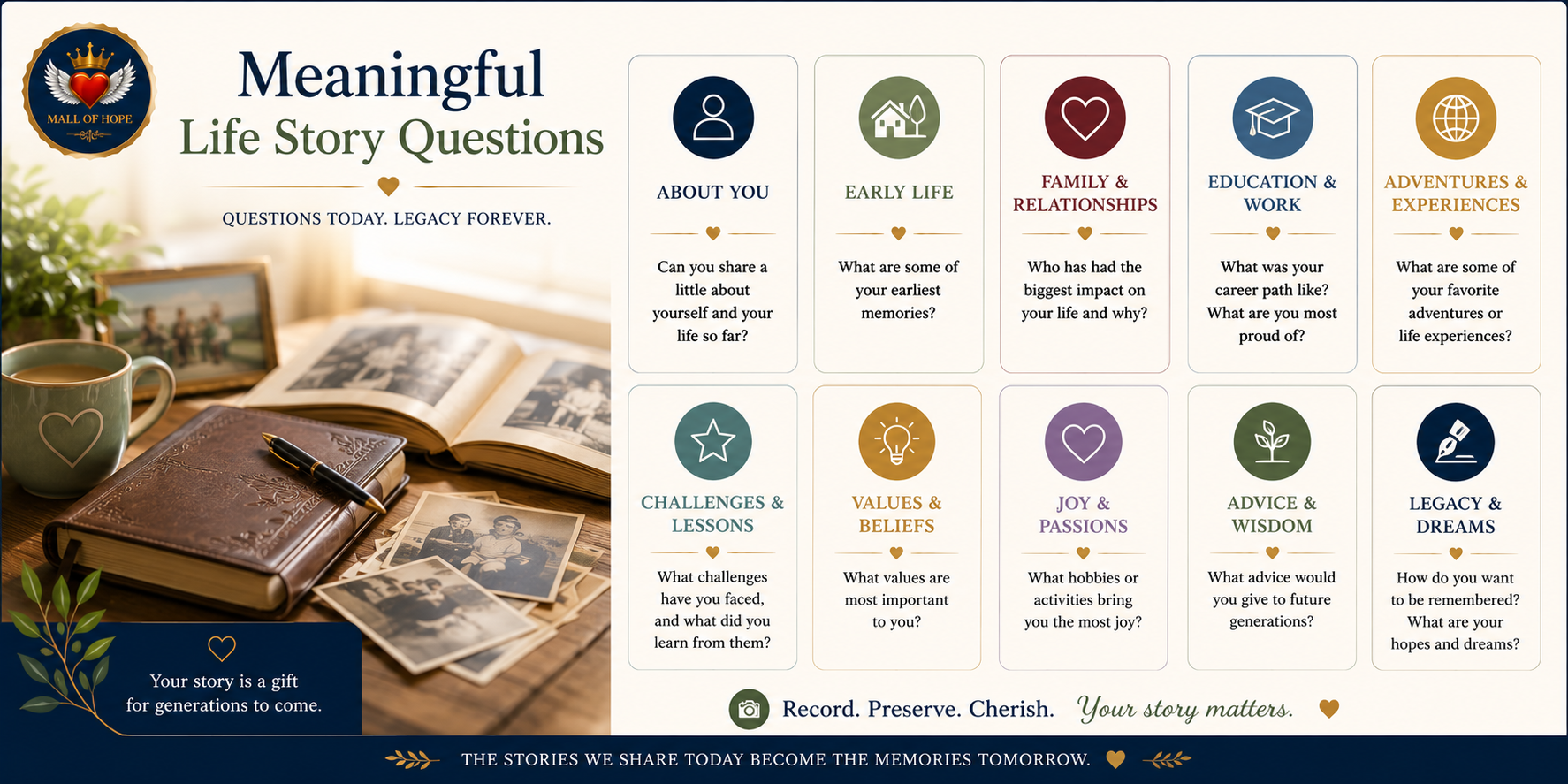

Every person has a story worth telling. Behind every photograph, family tradition, career, friendship, and milestone is a lifetime of experiences that shaped who someone became. Yet many of these stories disappear simply because no one asked the right questions. Choosing meaningful life story questions allows families to preserve memories, values, wisdom, and personal history while creating lasting connections across generations.
Life story interviews are about much more than recording dates or accomplishments. They help uncover the experiences, beliefs, relationships, and life lessons that define a person’s identity. Whether you are interviewing a parent, grandparent, spouse, veteran, church member, mentor, or recording your own memoir, thoughtful questions encourage authentic conversations that preserve both family history and personal legacy.
These conversations become especially valuable as loved ones age. Recording stories while communication remains strong helps preserve memories before Alzheimer’s disease, dementia, or other health changes affect recall. Research suggests that life review supports emotional well-being by helping older adults integrate their experiences into a meaningful life narrative (Butler, 1963). Person-centered care also emphasizes understanding an individual’s life history because personal stories, values, and relationships are essential to preserving dignity and providing compassionate care (Fazio et al., 2018).
Whether your goal is to create a professional life story interview, a legacy video, a written memoir, an audio recording, or a family history project, meaningful questions help transform ordinary conversations into priceless family treasures.
Why Meaningful Questions Matter
The quality of a life story interview depends largely on the questions that are asked. Questions that invite reflection often reveal far more than simple facts. Instead of asking for dates or short answers, meaningful questions encourage storytelling, emotion, and personal insight.
For example, asking “What year did you graduate?” may produce one answer.
Asking “What memories stand out most from your school years?” often opens the door to stories about friendships, teachers, dreams, challenges, and personal growth.
Open-ended questions also allow interviewees to reflect on what mattered most throughout their lives rather than focusing only on chronological events.
Research demonstrates that individuals who know more about their family history often develop greater resilience, emotional well-being, and a stronger sense of identity because they understand themselves as part of an ongoing family narrative (Duke et al., 2008). Meaningful interviews preserve that narrative while strengthening relationships between generations.
Most importantly, thoughtful questions communicate genuine interest. They tell parents, grandparents, and loved ones that their experiences deserve to be remembered.
Meaningful Life Story Questions by Topic
Childhood and Early Life
- What is your earliest childhood memory?
- What was your hometown like?
- What games did you enjoy as a child?
- Who influenced you the most growing up?
- What traditions did your family celebrate?
- What lessons did your parents teach you?
- What made you feel happiest as a child?
- What challenges helped shape your character?
Family and Relationships
- Tell me about your parents and grandparents.
- What family traditions are most meaningful to you?
- How did you meet your spouse?
- What was your wedding day like?
- What has marriage taught you?
- What are your favorite memories of raising children?
- What qualities make a strong family?
- What family stories should never be forgotten?
Education and Career
- What did you dream of becoming when you were young?
- What was your first job?
- Which career accomplishment makes you most proud?
- Who mentored or inspired you?
- What challenges did you overcome professionally?
- If you could give career advice to young people today, what would you say?
Faith and Personal Values
- What role has faith played throughout your life?
- Which values have guided your decisions?
- What Bible verse, quotation, or principle has influenced you most?
- When have you experienced hope during difficult seasons?
- What do you hope your family continues to value?
Life Lessons
- What has life taught you about happiness?
- What mistakes taught you the greatest lessons?
- What advice would you give your younger self?
- What are you most grateful for?
- What accomplishments matter most today?
- What would you like future generations to remember?
Legacy and Future Generations
- What are you most proud of?
- What hopes do you have for your children and grandchildren?
- What traditions should continue?
- What message would you leave for future generations?
- How would you like to be remembered?
- What does leaving a legacy mean to you?
These questions are intended to encourage conversation rather than interrogation. Some of the richest stories emerge naturally as one memory leads to another.
Using Life Story Questions in Dementia Care
Meaningful life story questions play an important role in person-centered dementia care. Individuals living with Alzheimer’s disease or other forms of dementia continue to possess rich personal histories, even as communication or recent memory becomes more challenging.
Recording stories during the early stages of dementia preserves detailed memories while allowing the individual to participate actively in sharing their own experiences.
Person-centered care recognizes that understanding someone’s biography improves communication, preserves dignity, and supports individualized care (Kitwood, 1997).
Life story interviews help caregivers learn about:
- Childhood experiences
- Family relationships
- Occupations
- Military service
- Hobbies
- Religious beliefs
- Favorite music
- Daily routines
- Personal achievements
- Meaningful life events
This information helps caregivers create conversations and activities that reflect the individual’s lifelong interests rather than focusing solely on medical needs.
Research supports life story work and reminiscence as evidence-based approaches that may improve communication, emotional well-being, and quality of life for many people living with dementia (Woods et al., 2018). Family photographs, legacy videos, memory books, and recorded interviews often encourage meaningful interaction while reinforcing identity.
Families are encouraged to begin life story interviews as early as possible, particularly after a diagnosis of mild cognitive impairment or early-stage dementia.
Turning Questions into a Lasting Legacy
A meaningful interview becomes even more valuable when it is thoughtfully preserved for future generations.
Many families transform interviews into:
- Professional life story videos
- Legacy documentaries
- Audio memoirs
- Written biographies
- Family history books
- Memory books
- Genealogy projects
- Voice recordings
- Digital family archives
- Personal history profiles
Combining interviews with photographs, letters, journals, recipes, military records, certificates, home movies, and family heirlooms creates a richer historical record while preserving both facts and emotions.
Long-term preservation is equally important. Families should maintain multiple copies using encrypted cloud storage, external hard drives, and offline backups stored separately. Written transcripts improve accessibility while making stories searchable for future family historians.
Life story interviews should also become an ongoing family tradition rather than a single conversation. Birthdays, anniversaries, reunions, retirements, holidays, and milestone celebrations all provide opportunities to record new memories and continue documenting the family’s evolving story.
Ultimately, meaningful life story questions do much more than gather information. They preserve identity, strengthen family relationships, capture wisdom, celebrate resilience, and ensure that ordinary lives are never forgotten. Every thoughtful question creates an opportunity for someone to say, “This is who I was. This is what I learned. This is what I hope you remember.” By asking these questions today, you create a lasting legacy that will continue inspiring children, grandchildren, and generations yet to come.
Frequently Asked Questions
What are meaningful life story questions?
Meaningful life story questions are open-ended prompts that encourage people to share memories, family history, values, life lessons, relationships, accomplishments, and personal experiences in their own words.
Why should I ask life story questions?
Life story questions preserve family history, strengthen relationships, document personal identity, capture wisdom, and create lasting memories for future generations.
Who should I interview?
Many people interview parents, grandparents, spouses, veterans, church members, community leaders, mentors, older relatives, or even record their own life story for future generations.
How do life story interviews help people living with dementia?
They preserve identity, support person-centered care, encourage reminiscence, strengthen communication, and help caregivers better understand the individual’s life history and personal preferences.
What is the best way to preserve life story interviews?
Professional legacy videos, audio recordings, written memoirs, family history books, digital archives, searchable transcripts, and multiple secure backups all help preserve these stories for future generations.
References
Brooker, D. (2007). Person-centred dementia care: Making services better. Jessica Kingsley Publishers.
Butler, R. N. (1963). The life review: An interpretation of reminiscence in the aged. Psychiatry, 26(1), 65–76.
Duke, M. P., Lazarus, A., & Fivush, R. (2008). Knowledge of family history as a clinically useful index of psychological well-being and prognosis. Journal of Family Life, 7(2), 133–140.
Fazio, S., Pace, D., Flinner, J., & Kallmyer, B. (2018). The fundamentals of person-centered care for individuals with dementia. The Gerontologist, 58(Suppl. 1), S10–S19.
Kitwood, T. (1997). Dementia reconsidered: The person comes first. Open University Press.
McAdams, D. P. (2008). Personal narratives and the life story. In O. P. John, R. W. Robins, & L. A. Pervin (Eds.), Handbook of Personality: Theory and Research (3rd ed., pp. 242–262). Guilford Press.
Woods, B., O’Philbin, L., Farrell, E. M., Spector, A., & Orrell, M. (2018). Reminiscence therapy for dementia. Cochrane Database of Systematic Reviews, 3, CD001120.
World Health Organization. (2023). Dementia. https://www.who.int/news-room/fact-sheets/detail/dementia