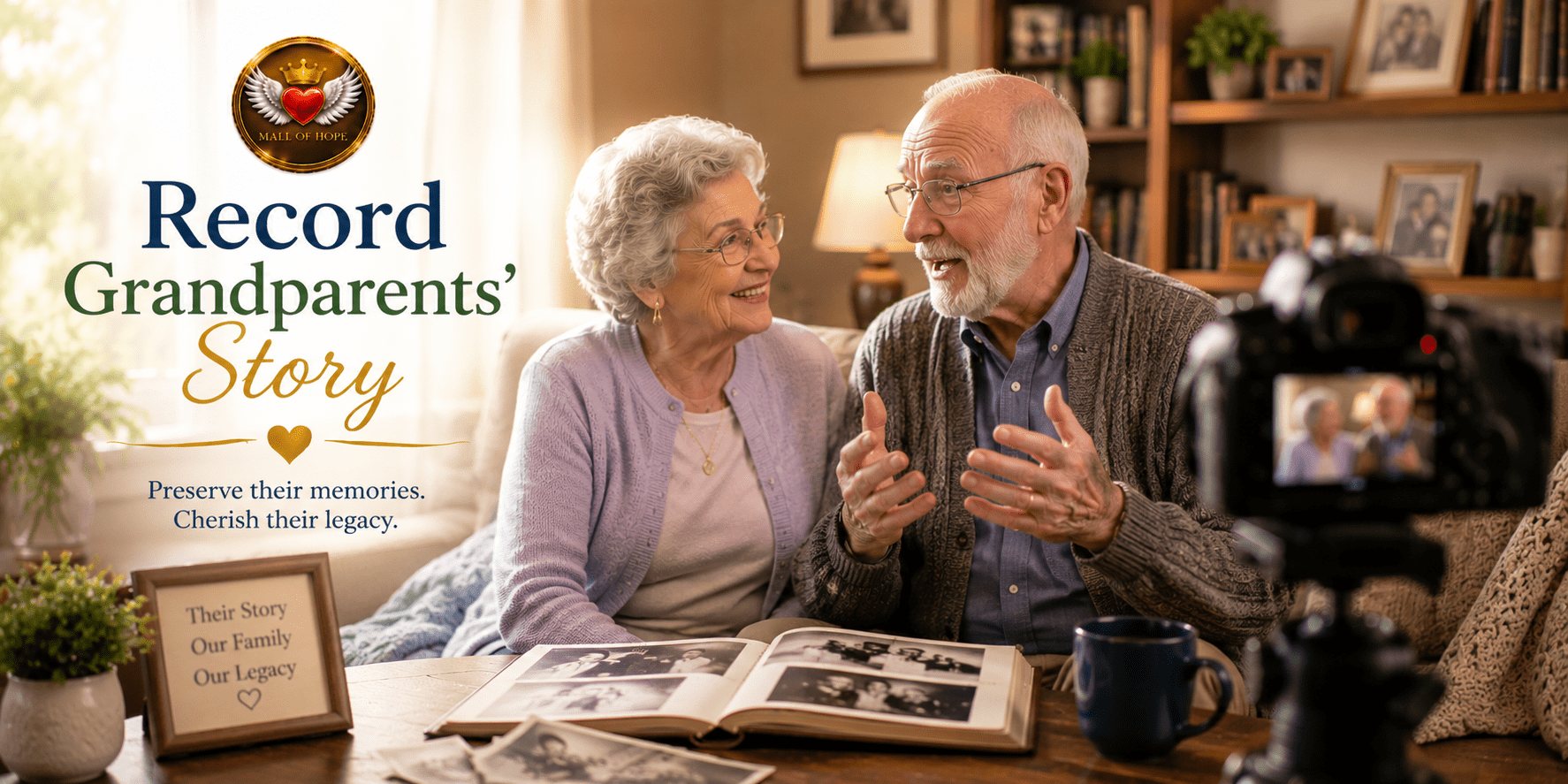

Grandparents are living libraries of family history. They remember the people, places, traditions, and experiences that shaped generations before us. They can tell stories about childhood during a different era, family celebrations, military service, immigration, careers, raising children, and the countless moments that helped build the family we know today. Yet these stories are often shared only in conversation, and unless they are intentionally preserved, they can disappear forever. Choosing to record your grandparents’ story ensures that their memories, wisdom, values, and voice become a lasting gift for children, grandchildren, and generations still to come.
Every family eventually reaches a moment when someone says, “I wish I had asked Grandma about that,” or “I wish Grandpa had told us more about his life.” These regrets are common because families often assume there will always be another opportunity to ask meaningful questions. Unfortunately, aging, illness, and memory changes can limit those opportunities. Recording your grandparents’ story today preserves the memories that future generations will one day treasure.
A professionally guided life story interview captures much more than dates and historical events. It preserves personality, laughter, emotion, values, faith, traditions, resilience, and the unique way your grandparents tell their stories. Through video recordings, audio interviews, written memoirs, and digital archives, families can create an enduring legacy that celebrates the lives of those who helped shape their family history.
Recording grandparents’ stories has become especially important as more families are affected by Alzheimer’s disease and other forms of dementia. Preserving memories while communication remains strong protects personal identity before cognitive decline progresses. Research suggests that life review and reminiscence promote emotional well-being, strengthen identity, and encourage psychological integration during later adulthood (Butler, 1963). These recordings also become valuable resources for caregivers while providing future generations with an authentic connection to the people who came before them.
Whether your grandparents are celebrating retirement, a milestone anniversary, a family reunion, or simply enjoying time with loved ones, recording their story is one of the most meaningful gifts your family can create.
Why Recording Your Grandparents’ Story Is So Important
Grandparents often possess knowledge that exists nowhere else. They remember family members who are no longer living, explain why traditions began, describe historical events from firsthand experience, and preserve stories that may never have been written down. Once these memories are lost, they cannot be recreated from photographs or official records alone.
Recording your grandparents’ story preserves family history in its richest form. Rather than simply documenting names and dates, it captures the emotions, humor, wisdom, values, and life lessons that reveal who they truly are. Future generations gain the opportunity to hear stories exactly as they were told, preserving authenticity that cannot be achieved through secondhand retellings.
Research indicates that children who know more about their family’s history often demonstrate greater resilience, emotional well-being, and confidence because they recognize themselves as part of an ongoing family narrative (Duke et al., 2008). Grandparents play a central role in preserving that narrative, helping younger generations understand not only where they came from but also the values and experiences that shaped their family.
The interview process also benefits grandparents themselves. Reflecting upon a lifetime of experiences encourages gratitude, reinforces identity, and provides an opportunity to recognize personal accomplishments and relationships. Butler (1963) described life review as an important developmental process that helps older adults integrate their experiences into a meaningful life story while supporting emotional well-being.
Families often discover remarkable stories during these conversations. Grandparents may share childhood memories, wartime experiences, immigration journeys, career accomplishments, courtship stories, parenting experiences, community involvement, and personal challenges that younger family members had never heard before. These discoveries strengthen family relationships while creating lasting memories during the interview itself.
Beyond preserving family history, grandparents’ stories contribute to community history. Their firsthand accounts document historical events, cultural traditions, local communities, and changing social conditions, creating valuable records that extend beyond the family.
What Should You Ask Your Grandparents?
Every grandparent has a unique life story, and thoughtful questions encourage meaningful conversations that go beyond simple facts. Rather than focusing only on dates and milestones, interviews should explore the experiences, relationships, values, and lessons that shaped their lives.
Professional life story interviews often include topics such as:
- Childhood memories and favorite family traditions
- Parents, grandparents, and early influences
- School experiences and lifelong friendships
- Military service or historical events they witnessed
- Careers and professional accomplishments
- Marriage and raising a family
- Faith, spirituality, and personal beliefs
- Cultural heritage and immigration stories
- Challenges overcome and lessons learned
- Advice for children, grandchildren, and future generations
Many families enhance these interviews by including old family photographs, home movies, handwritten letters, military medals, genealogy records, newspaper clippings, recipes, journals, awards, certificates, and treasured heirlooms. These items often trigger forgotten memories while adding valuable historical context to the recorded stories.
Grandparents’ stories can be preserved through several formats, including professionally filmed interviews, audio recordings, written memoirs, legacy books, documentaries, or secure digital archives. Combining multiple formats helps ensure the stories remain accessible and meaningful for future generations.
Authenticity should always remain the priority. The laughter between stories, emotional reflections, thoughtful pauses, and spontaneous memories often become the moments families cherish most because they preserve the grandparent’s genuine personality and character.
Recording Grandparents’ Stories Before Memory Changes
One of the most important reasons to record your grandparents’ story is to preserve their memories before Alzheimer’s disease or other forms of dementia affect communication. Although dementia gradually changes memory and language, it does not erase a person’s values, accomplishments, relationships, or emotional life. Recording stories early helps preserve these essential aspects of identity while communication remains strong.
Person-centered dementia care emphasizes understanding the whole person rather than focusing only on the diagnosis (Kitwood, 1997). A recorded life story provides caregivers with meaningful insight into occupations, hobbies, favorite music, military service, family traditions, cultural heritage, religious beliefs, and lifelong interests. This information supports compassionate, individualized care while reinforcing dignity and emotional connection.
For example, knowing that a grandparent spent decades as a teacher, nurse, veteran, artist, musician, engineer, farmer, entrepreneur, or volunteer helps caregivers create meaningful conversations and activities that reflect their life experiences. Familiar music, cherished recipes, treasured photographs, and beloved traditions often encourage reminiscence while promoting comfort and reducing anxiety.
Many families schedule life story interviews shortly after a diagnosis of mild cognitive impairment or early-stage dementia. Recording stories during this period preserves voices, humor, wisdom, and personality while memories remain relatively detailed. These recordings become priceless keepsakes that provide comfort throughout the progression of the disease and after the grandparent’s passing.
Professional caregivers also benefit from understanding a person’s life history. Rather than relying solely on medical records, they gain insight into values, relationships, coping strategies, communication styles, and important life experiences. This knowledge strengthens person-centered care planning while improving empathy and communication.
Research supports life story work and reminiscence as evidence-based interventions that may improve communication, mood, and quality of life for many individuals living with dementia (Woods et al., 2018). Recording your grandparents’ story provides a lasting foundation for these therapeutic approaches while preserving identity across generations.
Giving Future Generations the Greatest Family Gift
The greatest inheritance grandparents leave is often not financial wealth but the wisdom, traditions, memories, and love they pass to future generations. Recording their stories ensures these priceless gifts continue inspiring family members for decades to come.
Recorded interviews complement genealogy by bringing historical records to life. Birth certificates, census records, military documents, marriage licenses, and family trees establish important facts, while recorded conversations reveal the personalities, relationships, emotions, and experiences behind those records. Together, documentary evidence and oral history create a rich portrait of family identity.
Many families include grandparents’ interviews within broader legacy preservation projects that combine life story videos, written memoirs, genealogy research, oral histories, family photographs, journals, recipes, home movies, historical documents, and secure digital archives. These collections become living family histories that continue growing as each generation contributes its own stories.
Long-term preservation is essential. Families should maintain multiple secure digital backups using encrypted cloud storage and external hard drives while creating written transcripts for accessibility and future family research. Organizing recordings with descriptive names, interview dates, family relationships, and historical references ensures descendants can easily explore the archive for generations.
Recording grandparents’ stories should also become part of an ongoing family tradition. Holidays, birthdays, anniversaries, reunions, and milestone celebrations offer wonderful opportunities to continue documenting memories, preserving new stories, and capturing reflections that may not have been shared before.
Ultimately, recording your grandparents’ story is an act of love, gratitude, and preservation. It honors the lives they built, the sacrifices they made, the traditions they created, and the wisdom they hope to pass forward. Long after today’s conversations have ended, future generations will still be able to hear familiar voices, see warm smiles, and learn directly from the people who shaped their family’s history. By preserving your grandparents’ story today, you create a lasting legacy that will continue educating, inspiring, and connecting your family for generations to come.
Frequently Asked Questions
Why should I record my grandparents’ story?
Recording your grandparents’ story preserves their memories, family history, life lessons, traditions, and personal values before they are lost. It creates a lasting legacy that future generations can experience through their own voice and storytelling.
When is the best time to interview my grandparents?
The best time is now. Recording stories before memory or health changes occur helps preserve detailed memories, personality, and authentic life experiences while communication remains strong.
What questions should I ask my grandparents?
Ask about childhood memories, parents and grandparents, family traditions, education, careers, military service, marriage, parenting, faith, cultural heritage, challenges they overcame, favorite memories, and advice for future generations.
How does recording grandparents’ stories help families affected by dementia?
Recording stories before dementia progresses preserves identity, relationships, values, preferences, and communication. These recordings support person-centered care while providing lasting memories for loved ones.
How should my grandparents’ recorded stories be preserved?
Maintain multiple secure digital copies using cloud storage and external hard drives, create written transcripts, organize recordings with descriptive file names, and include them within your family’s genealogy and digital legacy archive for long-term preservation.
References
Brooker, D. (2007). Person-centred dementia care: Making services better. Jessica Kingsley Publishers.
Butler, R. N. (1963). The life review: An interpretation of reminiscence in the aged. Psychiatry, 26(1), 65–76.
Duke, M. P., Lazarus, A., & Fivush, R. (2008). Knowledge of family history as a clinically useful index of psychological well-being and prognosis. Journal of Family Life, 7(2), 133–140.
Kitwood, T. (1997). Dementia reconsidered: The person comes first. Open University Press.
McAdams, D. P. (2008). Personal narratives and the life story. In O. P. John, R. W. Robins, & L. A. Pervin (Eds.), Handbook of Personality: Theory and Research (3rd ed., pp. 242–262). Guilford Press.
National Institute on Aging. (2024). Alzheimer’s disease fact sheet. https://www.nia.nih.gov/health/alzheimers-and-dementia/alzheimers-disease-fact-sheet
Woods, B., O’Philbin, L., Farrell, E. M., Spector, A., & Orrell, M. (2018). Reminiscence therapy for dementia. Cochrane Database of Systematic Reviews, 3, CD001120.
World Health Organization. (2023). Dementia. https://www.who.int/news-room/fact-sheets/detail/dementia